
Replace Word for
Medical Writing
Studia is the medical writing platform that connects regulatory guidelines and learnings from past clinical studies. According to our clients, it helps them write 50 to 80% faster and, more importantly, better. Protocols, ICFs and CSRs live in one workspace and are written from one validated study record: change a value once and every document follows as a tracked change.
Compliance guardrails are built in from the first draft.
Trusted by medical writers at sponsors, CROs, and independent practices worldwide
Writing regulatory documents
in Word is broken
Weeks spent cross-checking guidelines
You toggle between Word, PDFs, and browser tabs to check ICH, EMA/FDA, CTR/MDR, and other local guidelines. Every citation is manual. Every format requirement is checked by hand.
Inconsistencies that slip through to submission
No automated compliance checking. Errors get caught late, or trigger amendments that cost hundreds of thousands and delay patient access to treatments.
Knowledge scattered across silos
Past protocols in shared drives. ClinicalTrials.gov and EU CTIS in separate tabs. PubMed in another. Internal SOPs and Meeting Notes somewhere else. Nothing connected, nothing searchable.
A purpose-built writing environment for clinical studies
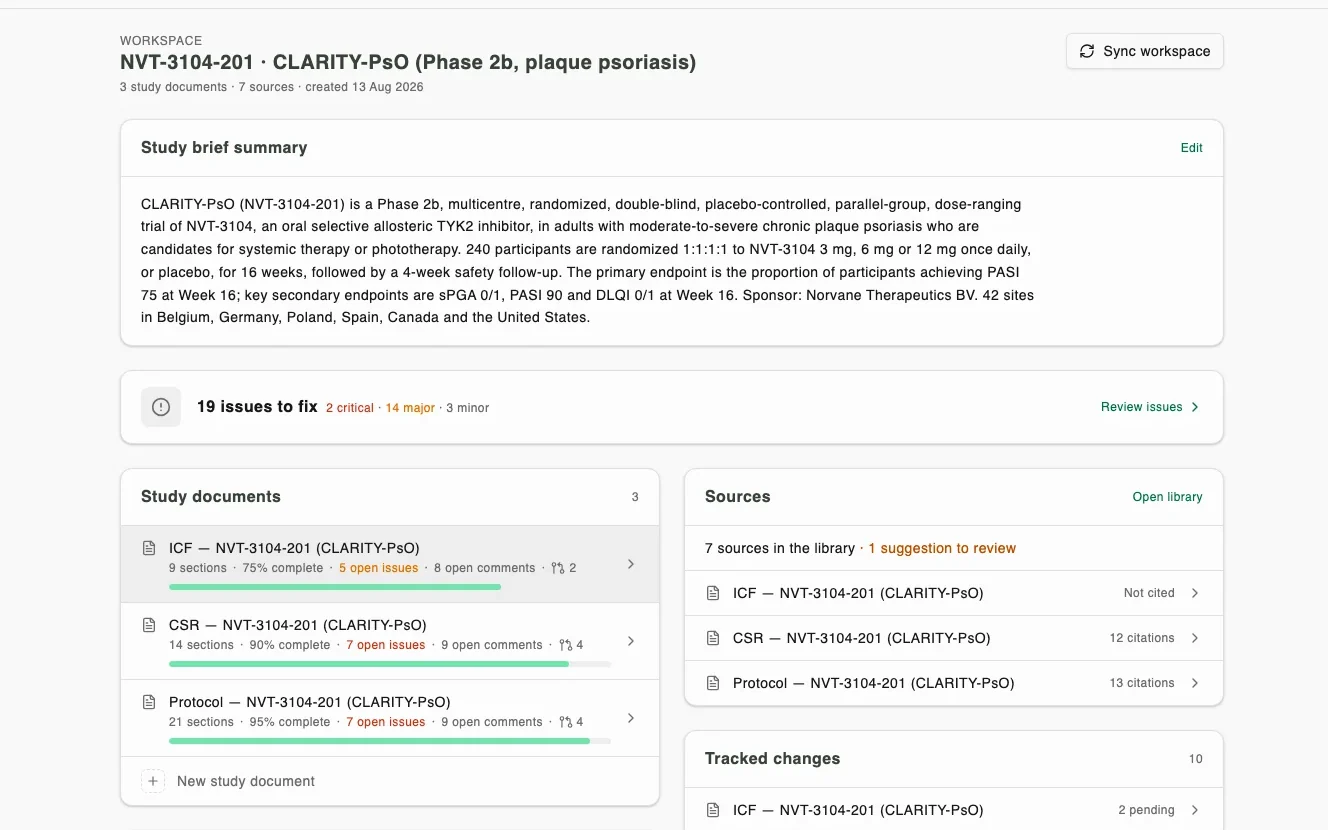
Studia brings regulatory guidelines, past clinical studies and AI into one workspace per study, so you write, collaborate, check and export compliant documents without leaving the platform. The study's data is one validated record the documents are written from, so a change is made once and reviewed as tracked changes everywhere it applies.
Change a value once. Every document follows.
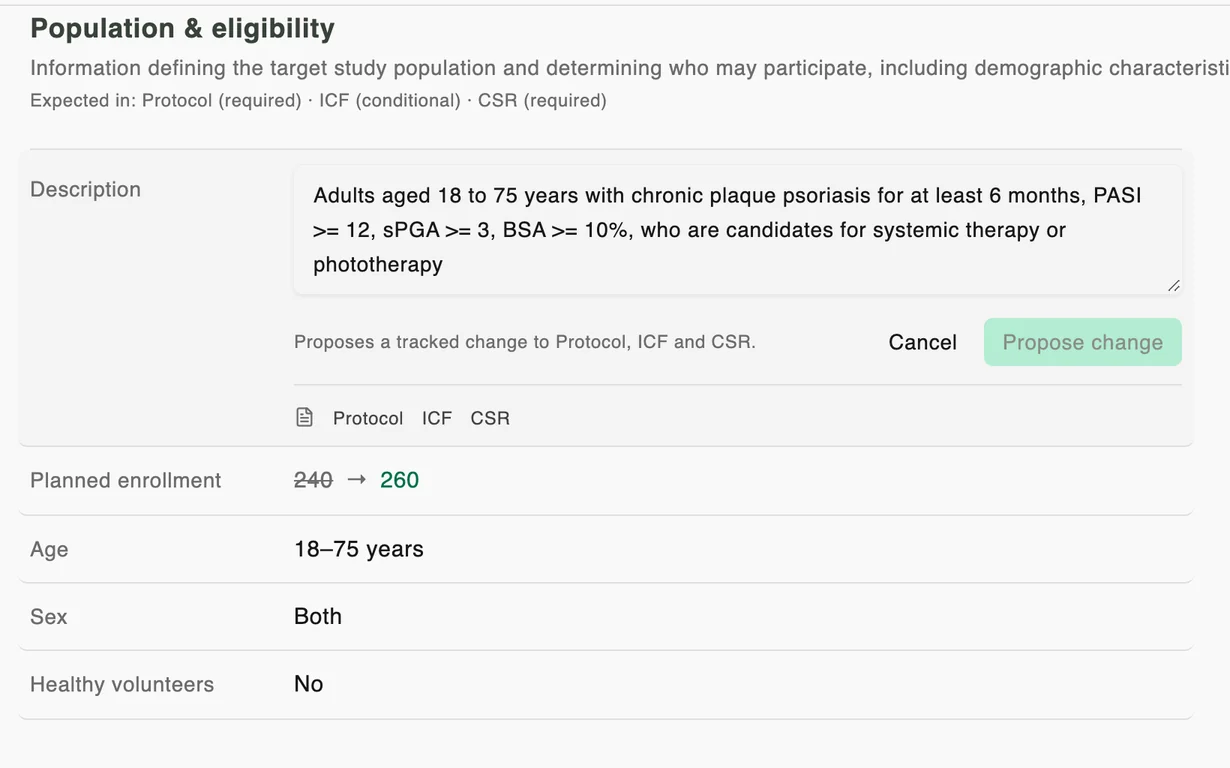
Planned enrollment goes from 240 to 260? Edit it in one place. Studia finds every paragraph that states it, in the protocol, the ICF and the CSR, and proposes each rewrite as a tracked change.
A total of 240 participants will be randomized 1:1:1:1 to the four treatment groups.
Tracked change · waiting for reviewAbout 240 people will take part in this study.
Tracked change · waiting for reviewThe planned sample size was 240 participants.
Tracked change · waiting for reviewOne controlled record
Design, population, endpoints, schedule and roles are read from your documents into one study record on the CDISC USDM model, validated with CDISC CORE.
Proposed, never imposed
Every rewrite lands in the documents as a tracked change with its reason. The author of each document accepts or rejects it, as with any reviewer.
Disagreements settled at the source
When the protocol and the ICF state different values, both are shown side by side. Pick the right one and the other document is corrected.
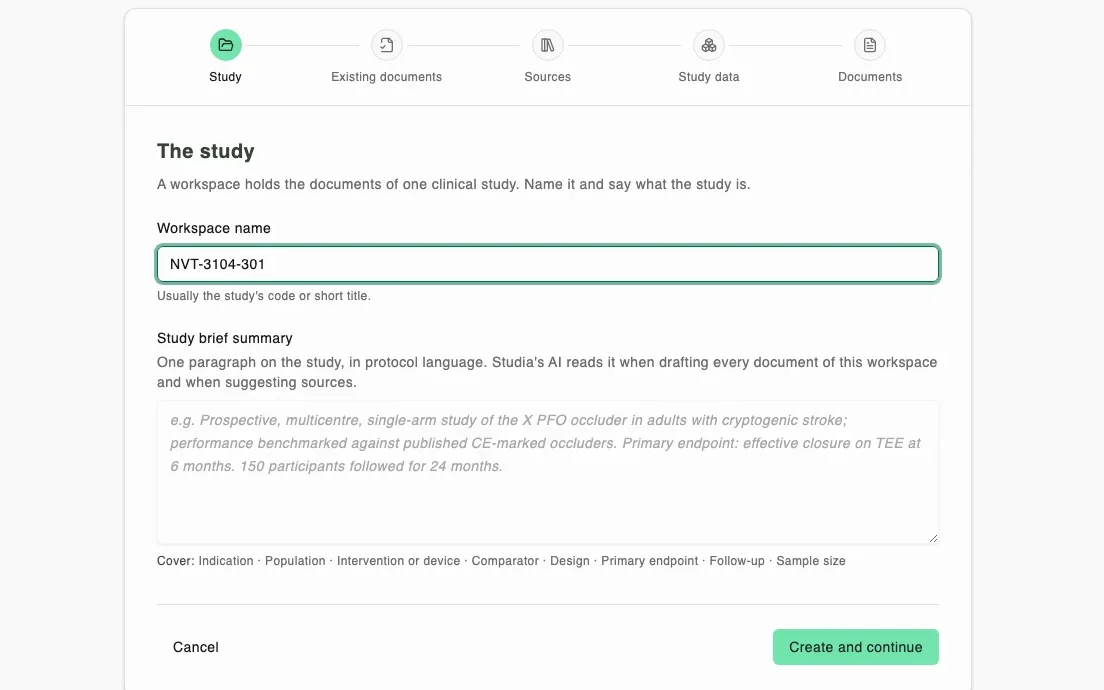
Start from your own documents
The New workspace wizard imports the Word files you already have, suggests and reads the sources, and settles the study's data (design, population, endpoints, schedule, roles) into one controlled record on the CDISC USDM model. It asks only what it cannot find, then drafts the first documents from that record.
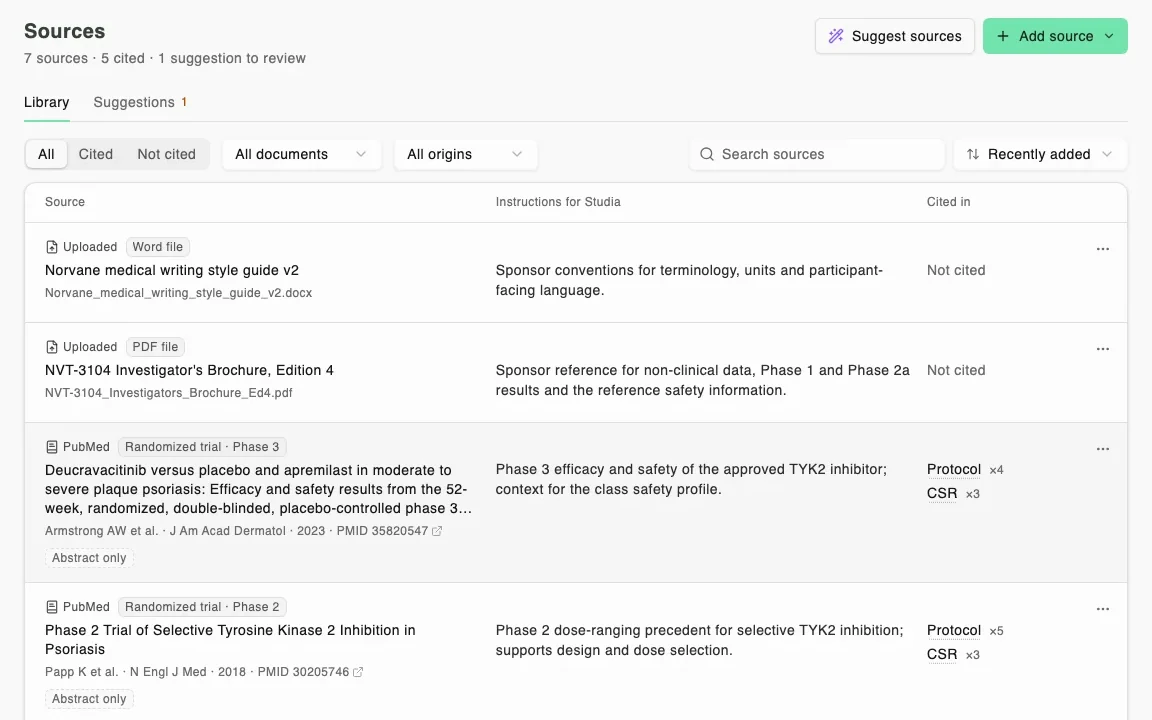
All your sources connected
PubMed, ClinicalTrials.gov, EU CTIS, preprints and your own files (investigator brochures, style guides, sponsor guidance) in one library every document of the study can cite. Each row says what the source is, why it is there and where it is cited. No more toggling between tabs.
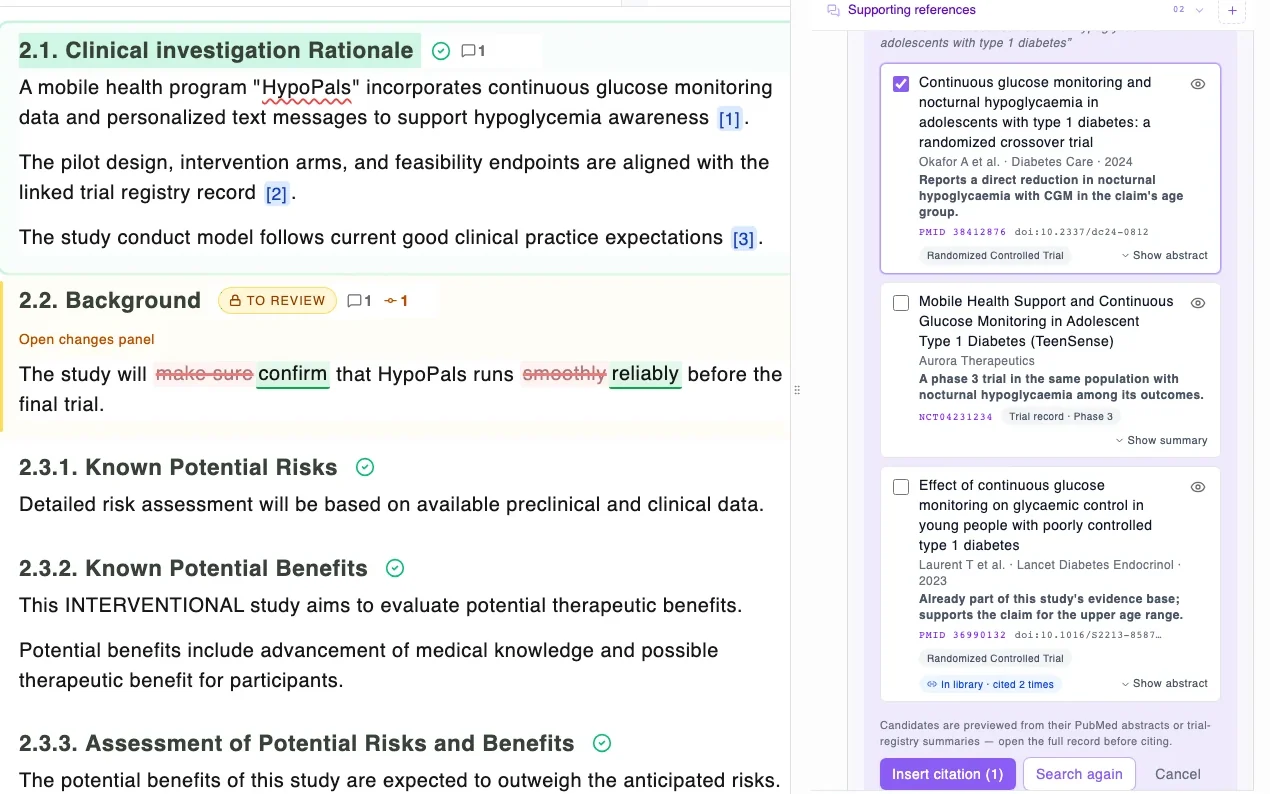
First drafts grounded in evidence
Generate content from the study record, the regulatory guidelines and the sources of the workspace, not hallucinated text. Ask the assistant to support a claim and candidates arrive on a review card: PubMed articles, trial-registry records, sources already in the library. Nothing is cited until you tick it.
Quality checks before reviewers see it
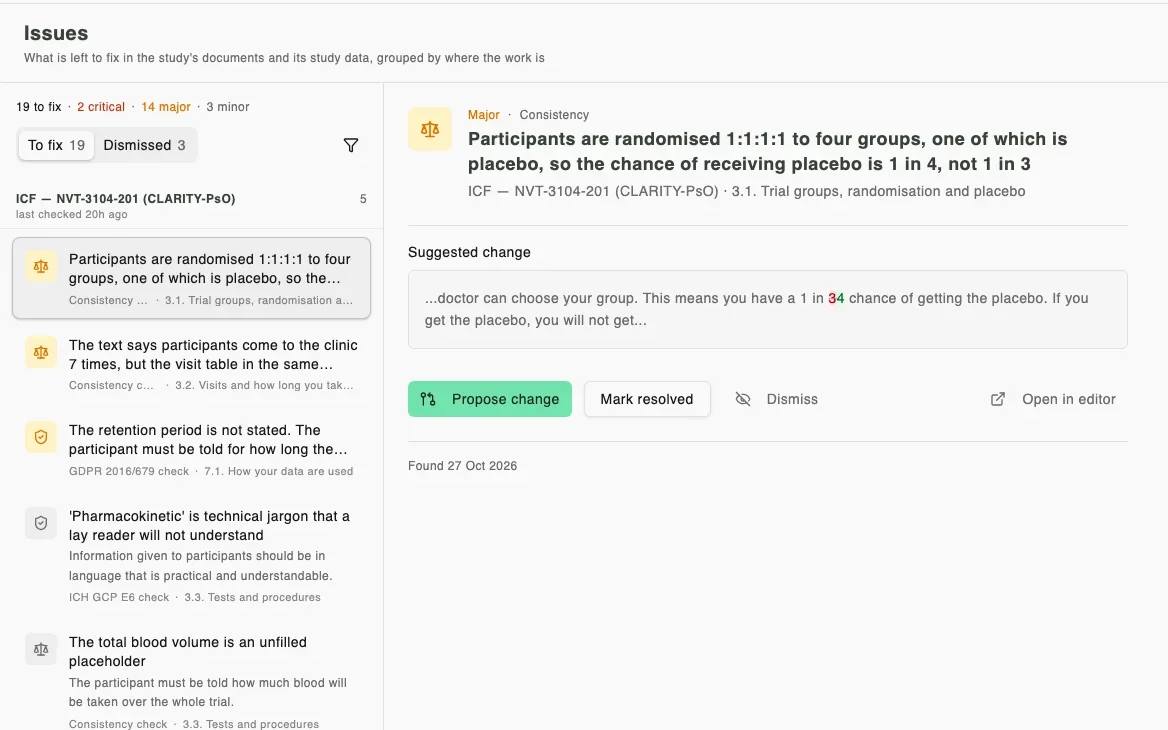
Guideline checks (ICH GCP, CTR, MDR, GDPR, …), consistency between the documents of the study and gaps in the study data land on one Issues list, each with a severity and a proposed change. When the protocol and the ICF say different things, pick the one that is right and the other is corrected with a tracked change. Every decision is recorded with who made it and when.
Review as you're used to
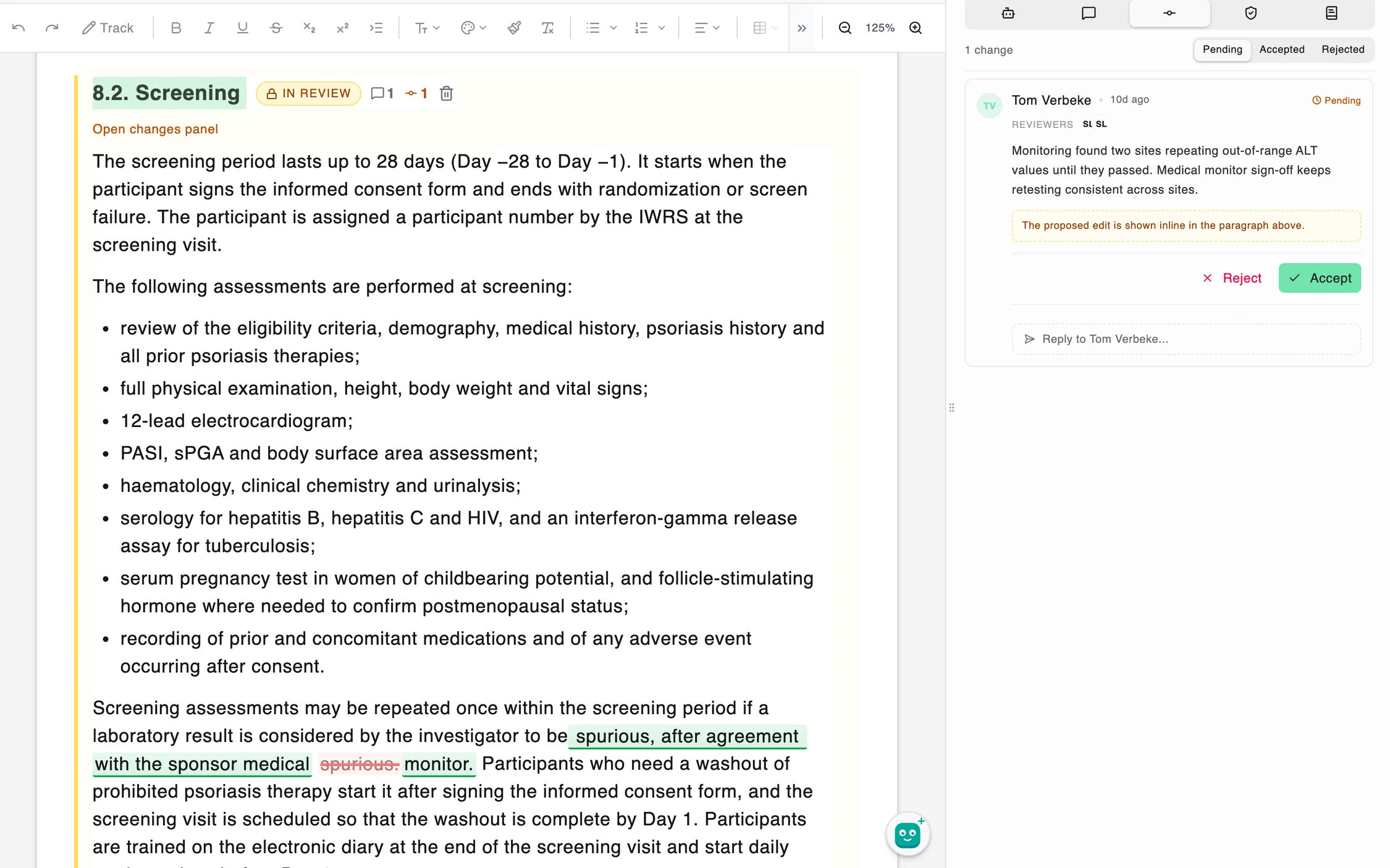
A Word-like editor that takes the whole screen while you write. Every edit a reviewer or the AI proposes is a tracked change with its author and reason, accepted or rejected in place. Comments, @-mentions and paragraph status keep sponsor and medical review in one thread, and a reviewed .docx comes back in with Update from Word.
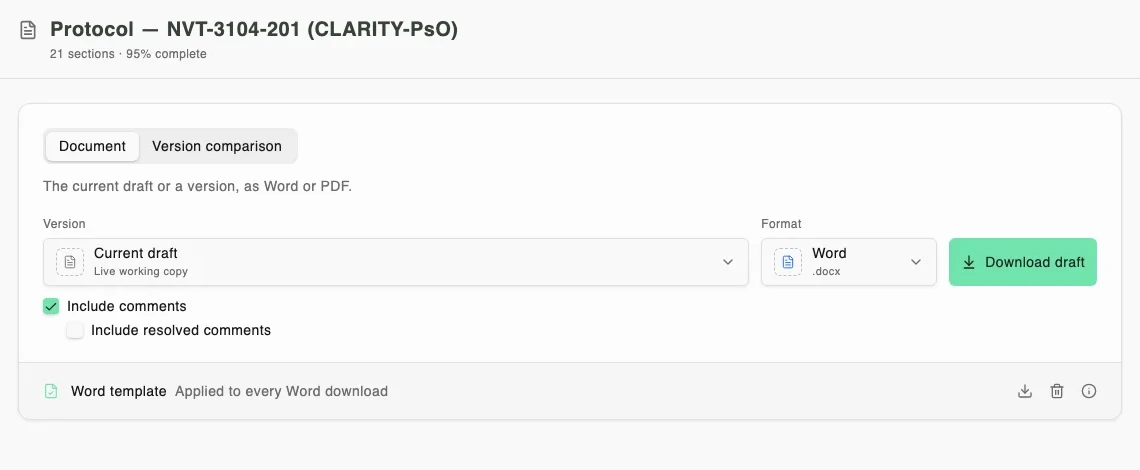
Exports to the standards
The study's data goes out as USDM JSON with conformance checks, the protocol as an ICH M11 Word document, and the registration as ClinicalTrials.gov and EU CTIS sheets, next to the Word and PDF documents you submit.
Versions and redlines
Name milestone versions, compare two of them as a Word redline, restore any of them.
A dashboard per document
Completion history, open issues, cited sources and the comments waiting on you.
Roles, seats and an audit log
Reader, reviewer, author, admin: per organization, scoped per workspace, every change recorded.
Hosted where you need it
The platform and its AI run in the EU, the US or APAC, or on-premise, whatever your organization requires.
Word and PDF export
Submission-ready documents with your own Word template, abbreviations and references included.
Your AI, with zero data retention
Zero data retention by default: your documents are never kept by the AI provider or used for training.




Trusted by medical writers worldwide
As Studia Health's first CRO partner, we are working closely with their team to help shape and optimize the platform based on real-world medical writing and clinical development needs. Studia's intuitive workspace, collaborative capabilities and AI-powered document generation streamline the creation of high-quality, compliant clinical documents. Combined with a highly responsive team, Studia is a valuable partner in driving efficiency, consistency and quality in medical writing. Great to see their perseverance along the way, and what they have achieved by now.

Studia has displayed foundational steps as a next-generation authoring environment for clinical protocol development. Its intuitive interface and ability to generate logical, compliant clinical text represent a clear advancement in operational efficiency.

Studia truly transforms how researchers develop clinical trial protocols. Its AI-driven precision, intelligent referencing from sources like ClinicalTrials.gov, and flexible editing features give researchers complete control over their work while saving an enormous amount of time.

A structured, user-friendly environment for creating clinical investigation plans with AI support and guideline integration. Source linking, export, and historical features support regulatory compliance and audit readiness.

The built-in AI assistant made my writing more accurate and cleaner, and helped me move through sections much faster. It brought in relevant studies and background details, saving me a lot of time searching.

Our Mission
We are dedicated to helping patients worldwide by accelerating clinical studies.
We streamline medical writing and regulatory documentation to bring life-saving drugs and medical devices to market faster. Every day saved in the approval process means more patients can access innovative treatments sooner.
Ready to replace Word?
Our clients write their documents 50 to 80% faster with Studia. Schedule a demo or get in touch with our Sales Team.
Contact our Sales Team
Tell us about your studies and documents, and we will get back to you.
sales@studia.health